My Blog List

Friday, May 15, 2026

Americans Pessimistic About the Economy

Economists told CNBC that consumers remain scarred from years of rapid price increases, even as the annual inflation rate cools. On top of that, Americans are worn out by a salvo of economic disruptions — from Covid to wars to President Donald Trump’s tariffs — that have defined the current decade.

“It’s a series of shocks,” said Yelena Shulyatyeva, senior economist at the Conference Board, which conducts another popular gauge of economic confidence. “Consumers don’t get a break.”


American consumers have been pessimistic for so long that now economists are wondering when — or even if — households will ever feel financially better off.

The University of Michigan Surveys of Consumers, a closely watched bellwether, hit all-time lows in May, according to a preliminary reading released last week. That is just one of several consumer opinion surveys showing Americans have never regained confidence in the U.S. economy since the Covid pandemic struck more than six years ago.

Economists told CNBC that consumers remain scarred from years of rapid price increases, even as the annual inflation rate cools. On top of that, Americans are worn out by a salvo of economic disruptions — from Covid to wars to President Donald Trump’s tariffs — that have defined the current decade.

“It’s a series of shocks,” said Yelena Shulyatyeva, senior economist at the Conference Board, which conducts another popular gauge of economic confidence. “Consumers don’t get a break.”
Price level pain
Economists and monetary policymakers typically track the rate of inflation over a 12-month time frame. By that measure, price growth is closer to the Federal Reserve’s target of 2% than to the four-decade highs seen during the pandemic.

But shoppers have focused on the cumulative change in prices over the past several years. From that vantage point, Cleveland Fed President Beth Hammack told CNBC, there’s been about a decade’s worth of inflation in half the time. 

“People are starting to hear that inflation is going down, but their box of cereal is still really expensive,” said Kyla Scanlon, an economic commentator known for coining the term “vibecession.”

“That feels really, really bad,” Scanlon said.

High prices have caused most of the decline in consumer sentiment between 2019 and 2026, according to a data analysis from PNC Financial Services. Sticker shock also explains why a model of economic conditions stopped moving in line with consumer sentiment over recent years, the bank’s analysis said.

Consumers are thinking more about the role of inflation in their lives. The share of respondents to Michigan’s survey who said they heard negative news about price growth or blamed that for their sour outlooks spiked after the pandemic began in 2020.

Google searches for the term “inflation” hit all-time highs earlier this year.

“No one cared about inflation until it became a problem,” said Brian LeBlanc, PNC’s senior economist. “Now, it’s something that everybody in the country is thinking about.”

One shock after another
There’s another reason economists believe confidence hasn’t rebounded: Consumers don’t have enough time to recover from one economic jolt before another raises its head.

“I can’t think of a period where you’ve had shocks like these,” said Eric Winograd, an alumnus of the New York Federal Reserve Bank who is now the chief economist at asset manager AllianceBernstein. “I’m not saying that these are the biggest in magnitude, but to have this many sequential events is extremely unusual.”

For sentiment to recover, U.S. consumers would need to see “positive” and “stable” economic conditions for several quarters, Georgetown University finance professor Francesco D’Acunto said. Instead of that, as geopolitical conflicts break out and as Trump continues his push for higher tariffs on trade partners, consumers have been getting “the opposite,” D’Acunto said.

The plunge in sentiment mirrors trends in reported happiness and trust in public institutions seen this decade.

“Consumer sentiment isn’t the only thing that really breaks around the pandemic,” said Joanne Hsu, the director of Michigan’s survey.

Open wallets
But despite what they tell pollsters, consumers, broadly speaking, have continued to open their wallets with abandon. Uber and Walt Disney last week reported strong customer spending, defying fears that shoppers would tighten their purse strings in response to price increases.

“The traditional correlation between sentiment and spending has largely broken down,” said Gregory Daco, chief economist at consulting firm EY-Parthenon. “We have to depart a little bit from the traditional analysis of these gauges because of the unique circumstances that we’re currently living through.”

As a result, AllianceBernstein’s Winograd said investors looking for a pulse check on consumers should monitor the direction of confidence indexes rather than pre-pandemic comparisons. Consumer opinion is still a low-tier economic data point for traders making investment decisions, he said.

The S&P 500 reached an all-time high on the same day last week that Michigan released its record-low consumer sentiment reading. The benchmark stock index has more than doubled, surging roughly 130%, since the start of 2020, while Michigan’s sentiment gauge has been cut in half, tumbling 52%.

“If this is the new normal, then this is the new normal,” Winograd said. “The question is: Are things getting better or worse?”

A ‘resilient’ consumer
In the near-term, sentiment is unlikely to improve as oil prices stay above $100 a barrel in the wake of the Iran war, several economists told CNBC.

The national average price for a gallon of gasoline soared past $4, the level at which a 2022 AAA survey found that a majority of Americans implement lifestyle changes. Gasbuddy, a price tracking platform, said its daily active user base nearly doubled in March as the war ramped up.

Whirlpool said last week that it experienced a “recession-level” decline in appliance demand due to cratering consumer confidence owing to the Middle East conflict. McDonald’s CEO Chris Kempczinski warned analysts that customer spending could take a hit as rising gas prices pressure pocketbooks.

What happens next in the job market can also dictate consumers’ feelings and behavior, Winograd said. Federal government data released last week showed the U.S. job market expanded more than economists expected in April, while still pointing to a “low-hire, low-fire” environment.

But even with these uncertainties and their gloomy views, American consumers — responsible for roughly two-thirds of all economic activity — are unlikely to crack, Winograd said.

“It’s a foolish man who bets against the U.S. consumer,” the economist said. “The base case has to be that the consumer continues to plug along.”

Source: CNBC, Alex Harring

Inflation

Inflation jumps to its highest level since 2023.

The U.S. war with Iran has pushed inflation to its highest level in almost three years.

Consumer prices in April were up 3.8% from a year ago, according to a report Tuesday from the Labor Department. That was the biggest annual increase since May 2023.

Prices rose 0.6% between March and April.

From gas prices to housing, here are three things to know about the rising cost of living.

Gas prices are a big driver
Gasoline prices have jumped sharply since the war began, snarling tanker traffic in the Strait of Hormuz, a vital corridor for energy shipments. The average price of regular gas is $4.50 a gallon, according to AAA. That's up 38 cents from a month ago. The jump in energy prices accounted for 40% of the monthly increase in the consumer price index in April.

Rising fuel costs are affecting other prices as well
When energy costs jump sharply, it can have spillover effects. Airfares, for example, jumped 2.8% last month and are more than 20% higher than they were a year ago, as airlines struggle with a spike in jet fuel prices. The cost of diesel fuel has risen by $1.88 a gallon since the war began. If that lasts, it could put upward pressure on the price of everything that's delivered by truck or train. Excluding volatile food and energy costs, "core" inflation was 2.8% in April.

Housing prices also contributed to higher inflation in April
Housing costs were also a driver of inflation, jumping 0.6% between March and April, but some of that is a statistical fluke resulting from the six-week government shutdown last fall. Government number crunchers were temporarily idled in October, so were unable to collect housing prices that month. That's had the effect of artificially lowering the measure of housing inflation. Tuesday's report provides a kind of catch-up.

Source: Scott Horsley, NPR

URC at UNH

The Undergraduate Research Conference (URC) is a celebration of academic excellence at the University of New Hampshire. In 2026, the URC celebrated its 27th year during a series of events, running from April 21 to 25. Around 1,800 UNH undergraduate students, from all academic disciplines, presented at the URC. The presentations showcased the results of students' research, scholarly, and creative projects in over 20 professional and artistic venues at both campuses (Durham and Manchester), making the UNH URC one of the largest and most diverse conferences of its kind in the country.

The URC session in the Peter T. Paul College of Business and Economics was held on Friday, April 24. Below is a list of the of the research projects conducted by ECON B.S. capstone students:


Kyle Chauvette, Nolan Jones, Aidan Kiley

The Effect of Telehealth on Health Care Costs


Jialin Chen, Molly Mikkonen

Public Debt and Economic Growth


Ariana DiGregorio, Savannah Nestler, Katherine Soucie

Major Economic Events and Students’ Choice of College Major


Willa-Maya Dowling, Cohan Drainville, Tim Mitus

 The Impact of Crime Rate Changes on Domestic Migration


Samuel Farrington, Skye Loto, Anna Steele

Assessing the Impact of Education Savings Accounts on 8th Grade Students’ Math and Reading Scores


Pierce-Gabriel Fiorini, Reid Osborne

Student Loan Debt and Homeownership


Jesse Harriott, Ryan Vogel

Occupational AI Exposure and the Wage Premium for Economics Majors


Tyler Truesdell, Andrew Turkington

The Economic Impact of the Olympic Games

Wednesday, May 28, 2025

Consumer Confidence Index

The Conference Board Consumer Confidence Index increased by 12.3 points in May to 98.0 (1985=100), up from 85.7 in April. The Present Situation Index—based on consumers’ assessment of current business and labor market conditions—rose 4.8 points to 135.9. The Expectations Index—based on consumers’ short-term outlook for income, business, and labor market conditions—surged 17.4 points to 72.8, but remained below the threshold of 80, which typically signals a recession ahead. The cutoff date for preliminary results was May 19, 2025. About half of the responses were collected after the May 12 announcement of a pause on some tariffs on imports from China.

“Consumer confidence improved in May after five consecutive months of decline,” said Stephanie Guichard, Senior Economist, Global Indicators at The Conference Board. “The rebound was already visible before the May 12 US-China trade deal but gained momentum afterwards. The monthly improvement was largely driven by consumer expectations as all three components of the Expectations Index—business conditions, employment prospects, and future income—rose from their April lows. Consumers were less pessimistic about business conditions and job availability over the next six months and regained optimism about future income prospects. Consumers’ assessments of the present situation also improved. However, while consumers were more positive about current business conditions than last month, their appraisal of current job availability weakened for the fifth consecutive month.”

May’s rebound in confidence was broad-based across all age groups and all income groups. It was also shared across all political affiliations, with the strongest improvements among Republicans. However, on a six-month moving average basis, confidence in all age and income groups was still down due to previous monthly declines.
Guichard added: “With the stock market continuing to recover in May, consumers’ outlook on stock prices improved, with 44% expecting stock prices to increase over the next 12 months (up from 37.6% in April) and 37.7% expecting stock prices to decline (down from 47.2% in April). This was one of the survey questions with the strongest improvement after the May 12 trade deal.”

Write-in responses on what topics are affecting views of the economy revealed that tariffs are still on top of consumers’ minds. Notably, consumers continued to express concerns about tariffs increasing prices and having negative impacts on the economy, but some also expressed hopes that the announced and future trade deals could support economic activity. While inflation and high prices remained an important concern for consumers in May, there were also some mentions of easing inflation and lower gas prices.

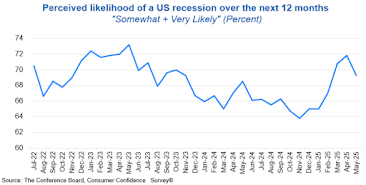
Consumers’ views of their Family’s Current and Future Financial Situations improved. The share of consumers expecting a recession over the next 12 months declined. (These measures are not included in calculating the Consumer Confidence Index®). Consumers’ expectations for interest rates ahead were little changed, while average 12-month inflation expectations eased to 6.5% after spiking at 7% in April.

Compared to April, purchasing plans for homes and cars and vacation intentions increased notably, with some significant gains after May 12. Plans to buy big-ticket items—including appliances and electronics—were also up. Likewise, consumers’ intentions to purchase more services in the months ahead, with almost all services categories rising. Dining out remained number one among spending intentions, followed by streaming services, while plans to spend on movies, theater, live entertainment, and sporting events increased the most over last month.

In a special question, consumers were asked if they changed their spending and financial behavior recently. More than a third (36.7%) said they put money aside for future spending. Around a quarter of consumers dug into their savings to pay for goods and services (26.6%) and postponed major purchases (26%). However, there were notable differences between income groups: Consumers in households making over $125K were more likely to say that they saved money while less wealthy households were more likely to have dug into their savings or postponed purchases. In addition, only 19% indicated having advanced purchases ahead of tariffs, but that share was higher for consumers in wealthier households (26%).

This month’s survey also asked consumers how worried they were about being laid off, not being able to afford necessities, and not being able to afford desired goods and services. Overall, they were more anxious about affordability than job security: Nearly half of consumers said they were concerned about not being able to buy the things they need or want, compared to less than a quarter worried about losing their jobs.

Present Situation

Consumers’ assessments of current business conditions improved in May.

21.9% of consumers said business conditions were “good,” up from 19.2% in April.
14.0% said business conditions were “bad,” down from 16.3%.
Consumers’ views of the labor market weakened in May.

31.8% of consumers said jobs were “plentiful,” up slightly from 31.2% in April.
18.6% of consumers said jobs were “hard to get,” up from 17.5%.
Expectations Six Months Hence       

Consumers were less pessimistic about future business conditions in May.

19.7% of consumers expected business conditions to improve, up from 15.9% in April.
26.7% expected business conditions to worsen, down from 34.9%.
Consumers’ outlook for the labor market outlook was also less negative in May.

19.2% of consumers expected more jobs to be available, up from 13.9% in April.
26.6% anticipated fewer jobs, down from 32.4%.
Consumers’ outlook for their income prospects turned positive in May.

18.0% of consumers expected their incomes to increase, up from 15.9% in April.
13.8% expected their income to decrease, up from 17.7%.
Assessment of Family Finances and Recession Risk

Consumers’ assessments of their Family’s Current Financial Situation improved in May. 
Consumers’ assessments of their Family’s Expected Financial Situation also improved.
Consumers’ Perceived Likelihood of a US Recession over the Next 12 Months declined in May.
 
Special Questions, May 2025
Many consumers indicated saving for future expenses, digging into their savings, and postponing major purchases… 
…but there are substantial differences in behavior based on household income
Consumers are more worried about the affordability of goods and services than losing their jobs
The monthly Consumer Confidence Survey®, based on an online sample, is conducted for The Conference Board by Toluna, a technology company that delivers real-time consumer insights and market research through its innovative technology, expertise, and panel of over 36 million consumers. The cutoff date for the preliminary results was May 19.

Source: May 2025 Consumer Confidence Survey

Wednesday, May 21, 2025

Leading Economic Index

The short-term outlook for the U.S. economy worsened significantly in April, according to the Conference Board's latest Leading Economic Index (LEI).

On Monday, the D.C.-based research said that the index—a closely monitored composite of several economic indicators—had fallen by 1.0 percent to 99.4 in April, registering the fifth consecutive monthly decline and the steepest drop since March 2023. Over the six months ending in April 2025, the LEI fell by two percent, matching the pace of decline posted over the previous six months.

The sharp decline in the LEI is one of the several warning signals that have emerged from the U.S. economy in recent months against the backdrop of trade policy uncertainty and a related weakening in consumer sentiment.

Despite the U.S. and China agreeing to a temporary climbdown on tariffs, set to extend into mid-August, separate consumer surveys suggest that economic anxieties persist. Economists have expressed concerns that the trade dispute may have already done damage to both economies, while cautioning over the strong possibility of a re-escalation.

Seven out of the ten economic components of the LEI declined in April, most significantly consumers' expectations for business conditions. As Justyna Zabinska-La Monica, Senior Manager for Business Cycle Indicators at the Conference Board noted: "Consumers' expectations have become continuously more pessimistic each month since January 2025."

According to the University of Michigan's latest Consumer Sentiment Index, consumer sentiment dropped for the fifth consecutive month in May to 50.8, the second-lowest reading on record.

Sentiment has dropped by nearly 30 percent since January, with Republicans contributing significantly to the decline seen this month. Meanwhile, year-ahead inflation expectations rose from 6.5 percent in April to 7.3 percent in May, while long-run inflation expectations were pushed up to 4.6 percent, "reflecting a particularly large monthly jump among Republicans."

Many of those surveyed mentioned the impact of tariffs in their responses, though the University of Michigan notes that most were gathered prior to last week's joint announcement of a temporary reduction in tariffs by the U.S. and China. The reaction to this pause assessed so far, it added, "echoes the very minor increase in sentiment seen after the April 9 partial pause on tariffs, despite which sentiment continued its downward trend."

While the Conference Board's forward-looking LEI serves as a potential warning signal, the Coincident Economic Index (CEI)—which reflects current conditions—edged up by 0.1 percent in April to 114.8, following a 0.3 percent gain in March.

What People Are Saying

Justyna Zabinska-La Monica, Senior Manager, Business Cycle Indicators, The Conference Board, said: "The U.S. LEI registered its largest monthly decline since March 2023, when many feared the US was headed into recession, which did not ultimately materialize.

"Most components of the index deteriorated. Notably, consumers' expectations have become continuously more pessimistic each month since January 2025, while the contribution of building permits and average working hours in manufacturing turned negative in April. Widespread weaknesses were also present when looking at six-month trends among the LEI's components, resulting in a warning signal for growth."

Federal Reserve Chair Jerome Powell, during a press conference on May 7, said: "Despite heightened uncertainty, the economy is still in a solid position. The unemployment rate remains low, and the labor market is at or near maximum employment. Inflation has come down a great deal but has been running somewhat above our two-percent longer-run objective."

Powell continued: "The new Administration is in the process of implementing substantial policy changes in four distinct areas: trade, immigration, fiscal policy, and regulation. The tariff increases announced so far have been significantly larger than anticipated. All of these policies are still evolving, however, and their effects on the economy remain highly uncertain."

Political economist Veronique de Rugy told Newsweek that despite the 90-day pause in U.S.-China tariffs, "the economic disruptions caused by the trade war have had tangible impacts, and the temporary nature of the agreement means that uncertainties persist."

Sean Metcalfe, associate director at Oxford Economics, said: "The effective tariff rate is still noticeably higher than that seen prior to President Donald Trump's inauguration. Over the span of several weeks, the US effective tariff rate skyrocketed to its highest since the late 1890s before settling slightly lower at a rate comparable with the 1930s. The bottom line is the US economy is still going to take a hit from the tariffs that remain in place."

Metcalfe told Newsweek that the tariff de-escalation would "boost GDP growth this year (relative to our previous forecast) by several 10ths of a percentage point, reduce the boost to y/y growth in consumer prices from tariffs by 0.2ppts, and nudge the unemployment rate lower by 0.1ppt-0.2ppts."

The Conference Board currently projects U.S. GDP to increase by 1.6 percent in 2025, slowed from 2.8 percent in 2024. It cited the adverse impacts of tariffs on America's growth prospects, with Zabinska-La Monica saying that the "bulk" of these will be felt in the third quarter of the year.

Source: Hugh Cameron, Newsweek

Monday, May 19, 2025

Moody’s Downgrading the U.S. Credit Rating

     
Moody’s has followed in the footsteps of credit rating agencies S&P Global and Fitch Ratings, downgrading the United States from their highest triple A rating.

The move comes amid ongoing challenges associated with mounting U.S. debt and little sign of significant debt reduction in Congress, despite recent actions from the Department of Government Efficiency, or DOGE.

Moody’s decision to lower the U.S. credit rating to Aa1 from Aaa follows similar decisions by Fitch Ratings in 2023 and S&P Global in 2011. It also adjusted its outlook to stable from negative to reflect the downgrade.

“While we recognize the US’s significant economic and financial strengths, we believe these no longer fully counterbalance the decline in fiscal metrics,” said Moody’s statement.

The federal budget deficit totals nearly $2 trillion annually, accounting for roughly 6.4% of gross domestic product (GDP).

The move isn’t likely to have a big impact on debt markets, given Fitch and S&P Global’s downgrades did little to slow down demand for Treasuries. The 10-Year Treasury Note currently yields 4.44%, up from 3.62% last September. That's about where it was in the mid-2000s.

Nevertheless, the downgrade reflects growing concern that sky-high deficits and government spending will put upward pressure on Treasury yields, forcing rates on everything from credit cards to mortgages higher over time.

Moody’s decision coincides with President Trump’s cornerstone tax and spending bill, which is currently under consideration by the House of Representatives.

The bill extends President Trump’s 2017 tax changes, while also including new provisions, such as increasing the Social Security income tax deduction and eliminating taxes on overtime and tips.

While the bill is popular among many eager for additional tax relief, some GOP members have blocked the bill, hoping for steeper cost cuts to offset the tax breaks. In the crosshairs is Medicaid, which is already the subject of cost-cutting in the bill.

The tax proposals could boost long-run GDP by 0.6% but reduce federal tax revenue by $4.1 trillion from 2025 through 2034, according to the non-partisan Tax Foundation.

The proposed tax cuts boost deficits by $3.8 trillion over the same period, or by 1.1% of GDP.

Five republicans voted against advancing the bill out of the Budget Committee and to the House floor for a vote.

“Republicans MUST UNITE behind, ‘THE ONE, BIG BEAUTIFUL BILL!’,” wrote Trump in a post on Truth Social. "We don't need 'GRANDSTANDERS' in the Republican Party. STOP TALKING, AND GET IT DONE!"

Source: Todd Campbell

Inflation

Inflation was slightly lower than expected in April as President Donald Trump’s tariffs just began hitting the slowing U.S. economy, according to a Labor Department report Tuesday.

The consumer price index, which measures the costs for a broad range of goods and services, rose a seasonally adjusted 0.2% for the month, putting the 12-month inflation rate at 2.3%, its lowest since February 2021, the Bureau of Labor Statistics said. The monthly reading was in line with the Dow Jones consensus estimate while the 12-month was a bit below the forecast for 2.4%.

Excluding volatile food and energy prices, the core CPI also increased 0.2% for the month, while the year-over-year level was 2.8%. The forecast was for 0.3% and 2.8%, respectively.

The monthly readings were a bit higher than in March though price increases remain well off their highs of three years ago.

Markets reacted little to the news, with stock futures pointing flat to slightly lower and Treasury yields mixed.

“Good news on inflation, and we need it given inflation shocks from tariffs are on their way,” said Robert Frick, corporate economist at Navy Federal Credit Union. “Non-tariffed goods are still in the pipeline, and perhaps some importers have absorbed their tariff costs for now.”

Shelter prices again were the main culprit in pushing up the inflation gauge. The category, which makes about one-third of the index weighting, increased 0.3% in April, accounting for more than half the overall move, according to the BLS.

After posting a 2.4% slide in March, energy prices rebounded, with a 0.7% gain. Food saw a 0.1% decline.

Used vehicle prices saw their second straight drop, down 0.5%, while new vehicles were flat. Apparel costs also were off 0.2% though medical care services increased 0.5%. Health insurance increased 0.4% while motor vehicle insurance was up 0.6%.

Egg prices tumbled, falling 12.7%, though they were still up 49.3% from a year ago.

With the increase in CPI, real average hourly earnings were flat for the month and up 1.4% from a year ago.

While the April CPI figures were relatively tame, the Trump tariffs remain a wild card in the inflation picture, depending on where negotiations go between now and the summer.

In his much-awaited “liberation day” announcement, Trump slapped 10% duties on all U.S. imports and said he intended to put additional “reciprocal” tariffs on trading partners. Recently, though, Trump has backed off his position, with the most dramatic development a 90-day stay on aggressive tariffs against China while the two sides enter further negotiations.

Economists figure that even with the easing of the 145% reciprocal tariffs against China, inflation numbers could perk up again in the summer months, though the degree to which that will happen is an open question. Trump left in place the across-the-board tariffs.

“Overall, there was no sign of the tariff impact in the April CPI. Although we expect higher tariffs will likely exert upward pressures on core CPI, starting in May, weakening of consumer demand and an inventory drawdown might mitigate the inflationary pressure,” Nomura economist Aichi Amemiya said in a note.

Markets expect the president’s softening position to lead to less of a chance of interest rate cuts this year. Traders had been expecting the Federal Reserve to start easing in June, with at least three total reductions likely this year.

Since the China developments, the market has pushed out the first cut to September, with just two likely this year as the central bank feels less pressure to support the economy and as inflation has held above the Fed’s 2% target now for more than four years.

The Fed relies more on the Commerce Department’s inflation gauge for policymaking, though the CPI figures into that index. The BLS on Thursday will release its April reading on producer prices, which is seen as more of a leading indicator on inflation.

Source: Jeff Cox, CNBC

Thursday, May 8, 2025

Hogan Lecture at UNH Paul College

During this year’s John A. Hogan Distinguished Lecture at the University of New Hampshire's Paul College of Business and Economics, economist Betsey Stevenson used a powerful comparison to show how far women have come: from 1950s images of women in the kitchen to Taylor Swift commanding billion-dollar stages.

While not everyone can be Taylor Swift, Stevenson emphasized that this shift isn’t just cultural—it’s economic. Technological change, legal reforms, and global trade have redefined women’s roles in both work and family life.

“Economics has a lot to tell us about how that transition happens,” Stevenson said. “Each decision you make creates an interdependency that shapes the constraints for the next decision.”

Stevenson — a professor at the University of Michigan’s Ford School of Public Policy and former U.S. Chief Economist — walked through the factors that transformed household dynamics. Innovations like washing machines and prepared foods reduced the need for skilled domestic labor, while trade made clothing and other goods cheaper, reducing the economic value of traditional homemaking.

At the same time, policy changes — from the Equal Pay Act to Title IX — opened doors for women in education and the workforce. The result is a new model of marriage and family. Women are marrying later, choosing partners based on shared interests rather than economic specialization, and increasingly balancing career and parenting.

“We're getting an increase in the age of first marriage, particularly among those with greater market skills,” Stevenson noted. “It’s more optimal to wait until you know what your adult interests are going to be.”

Stevenson also pointed to recent data showing women now surpass men in education and rebounding in labor force participation after COVID. But she cautioned that more work is needed.

“Today’s families are struggling with policies built for a time when one person handled everything at home,” she said. Stevenson expressed hope that AI and modern workplace tools could offer new flexibility. “I want those AI robots to give you the space to be with your families — not replace you, but support you."

Stagflation: What Is It and Who Is at Risk?

The Federal Reserve opted to leave interest rates unchanged on Wednesday, citing heightened risks of rising inflation and slowing growth, which have prompted renewed warnings about stagflation.

The decision came at the close of the Federal Open Market Committee's meeting. Policymakers held the federal funds rate steady at a target range of 4.25 percent to 4.5 percent, where it has remained since December 2024.

The Fed's latest statement acknowledged increasing uncertainty.

"Uncertainty about the economic outlook has increased further," the FOMC statement said. "The Committee is attentive to the risks to both sides of its dual mandate and judges that the risks of higher unemployment and higher inflation have risen."

This is the third consecutive meeting at which the Fed has held rates steady. It comes amid a trade war between the U.S. and China, in part after President Donald Trump implemented new, additional 145 percent tariffs on Chinese goods.

Further, Trump's trade policies have created some opposing pressures, complicating the Fed's moves.

While the FOMC statement did not reference tariffs, Federal Reserve Chairman Jerome Powell, speaking after the decision, said that given the scope of the tariffs, there will be risks of higher inflation and unemployment.

Regardless, Powell said he believes the Fed is prepared for how the tariff situation will play out, CNBC reported.

"There's just so much that we don't know, I think, and we're in a good position to wait and see, is the thing. We don't have to be in a hurry. The economy has been resilient. It's doing fairly well. Our policy is well-positioned," Powell said.

The decision to keep the federal funds rate steady was unanimous. The rate influences borrowing costs across the economy, including mortgages, credit cards, and business loans.

What Is Stagflation?

"Stagflation" is an uncommon but severe economic condition marked by stagnant growth, high inflation, and high unemployment, according to Fidelity Investments. The term merges "stagnation" and "inflation" and describes a scenario where prices rise even as the economy stalls or contracts.

According to Fidelity, stagflation's last major appearance in the U.S. came in the 1970s and early 1980s, driven in part by the oil embargo. In such conditions, the typical policy tools used to cool inflation, such as raising interest rates, can also worsen unemployment and sometimes suppress growth.

Who Is at Risk of Stagflation?

The implications of stagflation are broad, hitting both consumers and businesses. For households, purchasing power diminishes as prices outpace wage growth.

"Unless you're receiving regular raises to counteract inflation, your take-home pay may not be able to cover as much," Fidelity explained. "If unemployment is high, employers aren't likely to lift wages to compete for easy-to-find talent."

For investors, stagnation can drag on stock markets, as economic output slows and earnings decline. Meanwhile, fixed-income investments could be eroded by persistent inflation unless adjusted accordingly.

Businesses, particularly those reliant on imported materials or operating in industries with tight profit margins, may also suffer.

Earlier today, Trump doubled down on his position on China tariffs, saying he will not modify tariffs to initiate negotiations with the country.

As global markets respond to mixed economic signals, the next few months may prove critical in determining whether the U.S. economy can avoid a repeat of stagflation.

Source: Newsweek

Federal Reserve FOMC Meeting

The Federal Reserve on Wednesday held its key interest rate unchanged as it waits for the Trump administration’s trade policy to take shape and sees its impact on a sputtering economy.

In a move that carried little suspense given the wave of uncertainty sweeping the political and economic landscape, the Federal Open Market Committee held its benchmark overnight borrowing rate in a range between 4.25%-4.5%, where it has been since December.

The post-meeting statement noted the volatility and how that is factoring into policy decisions.

“Uncertainty about the economic outlook has increased further,” the statement said. “The Committee is attentive to the risks to both sides of its dual mandate and judges that the risks of higher unemployment and higher inflation have risen.”

While the statement did not specifically address the tariffs, Chair Jerome Powell addressed the issue at his post-meeting news conference.
Stocks briefly ceded some gains after the rate announcement but mostly recovered, with the Dow Jones Industrial Average up nearly 300 points despite some worries over the Fed’s characterization of the economic risks.

“The May FOMC statement in effect warns that a large trade shock is still set to hit the economy in spite of efforts by the Trump administration to deescalate, with the Fed seeing the risks ahead as two-sided and not providing any early dovish lean in favor of a June rate cut,” wrote Krishna Guha, head of global policy and central bank strategy at Evercore ISI. “The net implications for risk assets are negative.”

A possible stagflationary scenario

Finding the balance between the two elements of the Fed’s so-called dual mandate of full employment and stable prices has been made more difficult lately amid President Donald Trump’s tariff push.

In noting that tariffs both threaten to aggravate inflation as well as slow economic growth, the statement raises the possibility of a stagflationary scenario largely absent from the U.S. since the early 1980s.

Policymakers have largely been in agreement that the central bank is in a good position, with the economy generally holding up for now, to be patient as it calibrates monetary policy.

Powell emphasized this during the press conference. “The economy itself is still in solid shape,” he said.

The Fed’s deliberations come as the White House is locked on negotiations with top U.S. trading partners during a 90-day negotiating period that began in early April. Trump slapped 10% across-the-board tariffs on U.S. imports and threatened other individual “reciprocal” duties pending ongoing talks.

As near-daily headline changes gauge the trade war, the economy has been flashing conflicting signals on growth, inflation, and consumer and business sentiment.

Gross domestic product, the broadest measure of economic performance, fell 0.3% in the first quarter, the product of slower consumer and government spending and a surge in imports ahead of the tariffs. Most Wall Street economists expect the economy will return to positive growth in the second quarter.

The FOMC statement noted that “swings in net exports have affected the data,” and held to its recent characterization that the economy “has continued to expand at a solid pace.”

Indeed, job growth has held up despite Trump’s efforts to pare down the federal workforce. Nonfarm payrolls increased by 177,000 in April and the unemployment rate held at 4.2%, giving the Fed room to breathe if it expects a further economic slowdown.

Inflation has been ticking lower and approaching the Fed’s 2% target, but tariffs are expected to result in at least a one-time rise in prices. Trump has pushed the Fed to cut rates as inflation has eased. The central bank’s preferred gauge showed headline inflation at 2.3%, or 2.6% on core that excludes food and energy.

However, as with all aspects of the economy, it all depends on what happens with tariffs.

Trade talks in focus

Recent indications of progress in negotiations along with some softening from the administration have helped reverse a huge stock market sell-off after the April 2 “liberation day” announcement from Trump. However, business surveys show a high degree of anxiety, with most managers reporting concerns about supplies and pricing from the tariffs.

Market pricing regarding Fed action has been volatile as well.

Heading into the meeting, pricing indicated virtually no chance of a cut this week and less than 30% probability of a move in June, with the next reduction expected in July. Traders are pricing in a total of three cuts this year, though that could change following Wednesday’s decision.

The committee’s decision to hold the benchmark rate steady was unanimous. The fed funds rate is used by banks for overnight lending but also feeds into other consumer debt such as mortgages, auto loans and credit cards.

Source: Jeff Cox, CNBC

Friday, May 2, 2025

Nonfarm Payrolls

The U.S. labor market held up surprisingly well in April, as employers continued to hire at a healthy pace even when faced with dramatically higher tariffs. Nonfarm payrolls grew by 177K in the U.S. in April, topping the +130K consensus, but moderated slightly from the 185K added in March, according to data released by the U.S. Bureau of Labor Statistics on Friday.

The previous month's number, though, was revised down from +228K in its initial print. The BLS also revised February's print down by 15K to +102K, meaning that for the first two months of the year, there were 58K fewer jobs than previously reported.

The unemployment rate remained at 4.2%, as expected.

"The 177,000 increase in jobs and unemployment rate unchanged at 4.2% will strengthen the Federal Reserve’s no-action plan. It will likely hold rates, compared to earlier forecasts for a 25 bps cut at its May 6-7 meeting," said Chris Lau, Investing Group Leader for DIY Value Investing.

The labor participation force rate ticked up to 62.6% from 62.5%.

Health care, transportation and warehousing, financial activities, and social assistance continued to see increases in hiring, while federal government employment fell, the U.S. BLS said.

"The job increases in health care, transportation and warehousing, financial activities," Lau said. "DOGE activities led to a drop in federal government jobs. The government cut 9,000 jobs last month and 26,000 since January. The auto parts market lost 4,700 jobs. Although the government will lessen tariffs, be wary of industries with such headwinds. Investors should avoid firms like Magna (MGA), Advance Auto Parts (AAP), and Aptiv (APTV)."

Average hourly earnings rose 0.2% M/M in April, less than the +0.3% consensus, and slowing from the 0.3% increase in March. Y/Y, average hourly earnings increased 3.8%, less than +3.9% expected and +3.8% prior.

"Taken at face value, the April employment data displayed remarkable stability, leaving aside the question of the sustainability of that feature," said Mark Hamrick, senior economic analyst at Bankrate.

Equities reacted positively, with Nasdaq futures, S&P futures, and Dow futures each pulling up 0.9%. Bonds fell. The 10-year Treasury yield rose 6 basis points to 4.28%.

"While many will dismiss this report as 'the past,' these numbers suggest US economic resilience going into an uncertain period," said economist Mohamed A. El-Erian in a post on X. "With favorable supply and demand signals from the jobs report, it becomes virtually a certainty that the Federal Reserve will not cut interest rates next week."

Fitch Ratings' head of economic research, Olu Sonola, warns that economic uncertainty hasn't diminished. "For now, we should curb our enthusiasm going forward given the backdrop of trade policies that will likely be a drag on the economy," he said. "The key message coming from the totality of the data this week is that the U.S. economy was fundamentally strong through the first week of April, however, the outlook remains very uncertain."

Source: Liz Kiesche, Seeking Alpha

Thursday, May 1, 2025

URC at UNH


The Undergraduate Research Conference (URC) is a celebration of academic excellence at the University of New Hampshire. In 2025, the URC celebrated its 26th year during a series of events, running from April 21 to 26. More than 1,700 UNH undergraduate students, from all academic disciplines, presented at the URC. The presentations showcased the results of students' research, scholarly, and creative projects in over 20 professional and artistic venues at both campuses (Durham and Manchester), making the UNH URC one of the largest and most diverse conferences of its kind in the country.

The URC session in the Peter T. Paul College of Business and Economics was held on Friday, April 25. Below is a list of the of the research projects conducted by ECON B.S. capstone students:

MJ Condon, Victoria Drake, Joseph Skehan
Gross National Happiness and the Economy
 
Reece Apgar, Sam Croteau, Aiden Giarnese, Logan Patrick
The New England Energy Market
 
Jaelin Cummings, Taya Morgado, Ryan O'Malley 
Rising Income Inequality in the U.S.
 
Key Factors Affecting the Import Ratio
Drew Dickson, Brennan Dwyer, Spencer Quillen, Nick Weatherbie
 
Mather Kipka, Merlim Llanes Cardenas, Sofia Menyalkin, Kyle Santangelo
Factors Affecting the Homeownership Rates
 
Kara Cataldo, John Ecklund, Ria Talwar
The Economic Impact of Climate Change
 
Sean Bradley, Charles Craig, Kyle Heidt
Analyzing Consumer Spending in the Live Entertainment Industry
 
Drew Bircher, Kyle Burditt, Ryan Luis
Stock Market Effect on Consumption
 
Aidan Dormady, Maximus Guth, Jamie Keep, Paul Sullivan 
Factors That Impact the U.S. Housing Market
 
Jason Lee, Stephen Mague, Colby Walsh
Retirement and Labor Force Participation

Wednesday, April 30, 2025

Recession ?


The U.S. economy shrank at a 0.3% annual pace from January through March, the first drop in three years, as President Donald Trump’s trade wars disrupted business. First-quarter growth was slowed by a surge in imports as companies in the United States tried to bring in foreign goods before Trump imposed massive tariffs.

The January-March drop in gross domestic product — the nation’s output of goods and services — reversed a 2.4% gain in the last three months of 2024. Imports grew at a 41% pace, fastest since 2020, and shaved 5 percentage points off first-quarter growth. Consumer spending also slowed sharply — to 1.8% growth from 4% in October-December last year. Federal government spending plunged 5.1% in the first quarter.

Forecasters surveyed by the data firm FactSet had, on average, expected the economy to eke out 0.8% growth in the first quarter, but many expected GDP to fall.

Financial markets sank on the report. The Dow Jones tumbled 400 points at the opening bell shortly after the GDP numbers were released. The S&P 500 dropped 1.5% and the Nasdaq composite fell 2%.

The surge in imports — fastest since 1972 outside COVID-19 economic disruptions — is likely to reverse in the second quarter, removing a weight on GDP. For that reason, Paul Ashworth of Capital Economics forecasts that April-June growth will rebound to a 2% gain.

Trade deficits reduce GDP. But that’s mainly a matter of mathematics. GDP is supposed to count only what’s produced domestically. So imports — which the government counts as consumer spending in the GDP report when you buy, say, Swiss chocolates — have to be subtracted out to keep them from artificially inflating domestic production.


And other aspects of Wednesday’s GDP report suggested that the economy looked solid at the start of the year.

A category within the GDP data that measures the economy’s underlying strength rose at a healthy 3% annual rate from January through March, up from 2.9% in the fourth quarter of 2024. This category includes consumer spending and private investment but excludes volatile items like exports, inventories and government spending.

Still, many economists say that Trump’s massive import taxes — the erratic way he’s rolled them out — will hurt growth in the second half of the year and that recession risks are rising.

“We think the downturn of the economy will get worse in the second half of this year,’' wrote Carl Weinberg, chief economist at High Frequency Economics. “Corrosive uncertainty and higher taxes — tariffs are a tax on imports — will drag GDP growth back into the red by the end of this year.’'

Wednesday’s report also showed an increase in prices that is likely to worry the Federal Reserve which is still trying to cool inflation after a severe pandemic run-up. The Fed’s favored inflation gauge – the personal consumption expenditures, or PCE, price index – rose at an annual rate of 3.6%, up from 2.4% in the fourth quarter. Excluding volatile food and energy prices, so-called core PC inflation registered 3.5%, compared with 2.6% from October-December. The central bank wants to see inflation at 2%.

The first-quarter GDP numbers “highlight the bind that the Federal Reserve is in,” Ryan Sweet of Oxford Economics wrote in a commentary. The Fed must weigh whether to cut interest rates to support economic growth or leave rates high because of elevated inflation. “The economy was essentially stagnant in the first three months of the year while growth in headline and core inflation accelerated, fanning concerns of stagflation.’’

Trump inherited a solid economy that had grown steadily despite high interest rates imposed by the Fed in 2022 and 2023 to fight inflation. His erratic trade policies — including 145% tariffs on China — have paralyzed businesses and threatened to raise prices and hurt consumers.

Democrats were quick to blame Trump for disrupting several years of solid economic growth. Democratic Sen. Elizabeth Warren of Massachusetts said: “100 days into his presidency, Donald Trump’s red-light, green-light tariffs are shrinking our economy, with businesses stockpiling imports in anticipation of tariff doomsday.″

There is potential evidence emerging that the solid job market, a pillar of the U.S. economy during the pandemic recession, may be weakening.

On Wednesday, payroll provider ADP reported that companies added just 62,000 jobs in April, about half of what was expected, and down from 147,000 in March. That could be a signal that businesses may be taking a more cautious approach to hiring amid uncertainty over tariffs. Still, the ADP figures often diverge from the government’s jobs reports, which arrive Friday.

Employers in the education and health, information technology, and business and professional services industries all cut jobs. Business and professional services include sectors such as engineering, accounting and advertising.

“Unease is the word of the day,” said Nela Richardson, chief economist at ADP. “It can be difficult to make hiring decisions in such an environment.”

Source: Christopher Rugaber, The Associated Press

Tuesday, April 29, 2025

Consumer Confidence

Consumer attitudes about both the present and near future dimmed again in April, as tariffs dented sentiment and confidence in employment hit levels last seen around the global financial crisis.

The Conference Board’s Consumer Confidence Index fell to 86 on the month, down 7.9 points from its prior reading and below the Dow Jones estimate for 87.7. It was the lowest reading in nearly five years.

However, the view of conditions further out deteriorated even more.

The board’s expectations index, which measures how respondents look at the next six months, tumbled to 54.4, a decline of 12.5 points and the lowest reading since October 2011. Board officials said the reading is consistent with a recession.

“The three expectation components—business conditions, employment prospects, and future income—all deteriorated sharply, reflecting pervasive pessimism about the future,” said Stephanie Guichard, the board’s senior economist for global indicator.

Guichard added that the confidence surveys overall were at “levels not seen since the onset of the Covid pandemic.”

Indeed, the level of respondents expecting employment to fall over the next six months hit 32.1%, “nearly as high as in April 2009, in the middle of the Great Recession,” Guichard added. That contraction lasted from December 2007 until June 2009. The level of respondents seeing jobs as “hard to get” rose to 16.6%, up half a percentage point from March, while those seeing jobs as “plentiful” fell to 31.7%, down from 33.6%.

Future income prospects also turned negative for the first time in five years.

The downbeat views extended to the stock market, with 48.5% expecting lower prices in the next 12 months, the worst reading since October 2011. Inflation expectations also surged, at 7% for the next year, the highest since November 2022.

Driving the pessimism was fear over tariffs, which reached an all-time high for the survey. Recession expectations hit a two-year high as well.

Source: Jeff Cox, CNBC

Saturday, April 26, 2025

Durable Goods Orders


Orders placed with US factories for business equipment barely rose in March, suggesting firms are growing cautious amid uncertainty surrounding tariffs and tax policy.

The value of core capital goods orders, a proxy for investment in equipment excluding aircraft and military hardware, increased 0.1% last month after a revised 0.3% decline in February, Commerce Department figures showed Thursday. Shipments of core capital goods rose at a slower pace.

Bookings for all durable goods — items meant to last at least three years  — surged 9.2%, the most since July on a 139% jump in orders for commercial aircraft.

The moderation in capital goods orders suggests companies were growing cautious about investing in their operations ahead of President Donald Trump’s early-April announcement of sweeping tariffs. A fluid trade-policy is fueling uncertainty elevated, leaving businesses’ capital spending plans in limbo while also raising concerns about the economic outlook.

In the meantime, while business leaders and investors wait for the administration to wrap up negotiations on a number of bilateral trade deals, lawmakers on Capitol Hill are still working on tax-cut legislation.

Metric                                                                       Actual        Estimate

Durable goods orders                                           +9.2%      +2.0%

Capital goods orders excl. defense & aircraft           +0.1%      +0.1%

Capital goods shipments, excl. defense & aircraft   +0.3%      +0.2%

Rather than orders that can be canceled, the government uses data on shipments as an input to gross domestic product, which reflects when a payment has been made. Core capital goods shipments rose 0.3% after a revised 0.7% gain.

Economists like to look at the core shipments figure for a cleaner sign of underlying sales since there are extremely long times between ordering commercial aircraft and military equipment and the actual shipment taking place.

Non-defense capital goods shipments including aircraft, which feed directly into the equipment investment portion of the gross domestic product report, dropped 1.9%, the most since October. The latest figure, dragged down by commercial aircraft, suggests a weak finish to the first quarter ahead of the government’s initial estimate of GDP next week.

After the durables report, the Federal Reserve Bank of Atlanta’s GDPNow forecast penciled in a 0.74 percentage point contribution from business equipment spending for the quarter, which would be the most in three years.

The Commerce Department’s report showed the increase in bookings for commercial aircraft, which are volatile from month to month, was the largest since July.

Boeing Co. said it received 192 orders in March, the most since the end of 2023 and up from 13 in the previous month. At the same time, China recently ordered its airlines not to take further deliveries of Boeing jets as the trade war escalates. 

Manufacturing surveys suggest tougher sledding ahead. S&P Global’s flash April factory index hovered near stagnation for a second month. A gauge of Philadelphia-area manufacturing tumbled nearly 39 points this month and showed the steepest contraction in two years.

Source: Mark Niquette, MSN

Friday, April 25, 2025

US Economic Outlook - April 2025

Changes in US trade policy are having a profound impact on the global economy and financial markets. The US administration’s on-off tariff policy has led to a confidence crisis with businesses favoring a wait-and-see approach in the face of historically elevated policy uncertainty. US consumer sentiment gauges have plunged to their lowest levels since the 1980s while forward-looking business confidence measures are at multiyear lows. And while this malaise has yet to precipitate a retrenchment in consumer spending and business investment — tariff front-running even lifted March spending — heightened financial market volatility and diminished appetite for dollar-denominated assets pose significant risks to the US economic outlook.

Factoring these developments, we have made notable adjustments to our baseline outlook. The US average tariff rate has risen by about 22 percentage points (ppt) to 24% as of April 20. We assume exemptions along with a reduction of tariffs on China will bring the average tariff rate closer to 17% through most of Q2 and Q3. From Q4 onward, we anticipate trade deals will bring the average tariff rate down to 13% — representing a 10ppt increase relative to 2024. We maintain our expectations regarding an extension of most expiring tax cuts paid for by modest spending cuts. We also maintain our lower net immigration estimates at 800,000 per year over the next four years.

We have cut our real GDP growth forecast to 1.1% for 2025 and 2026, from 1.7% and 1.6%, respectively, in our prior baseline. Importantly, the anticipated real GDP growth will approach stall speed in Q4 with growth at only 0.2% year over year (y/y). While we see the odds of a recession in the next 12 months around 45%, risks to the outlook are tilted to the downside.

Pressures on labor demand and supply: The strong 228,000 payroll gain in March is a reminder that economic fundamentals were robust heading into the tariff storm. Yet, downside risks to the labor market have escalated significantly in recent weeks. The unemployment rate stood at a still historically low 4.2% in March, but it’s poised to rise toward 5% as economic activity slows and business leaders look to manage labor costs amid elevated imported input cost. We foresee job growth decelerating from 160,000 per month in 2024 to around 50,000 in 2025 and believe the decline in net immigration flows will constrain labor supply dynamics.  

Worried consumers front-run tariffs: Faced with extreme uncertainty, consumers rushed to buy durable goods in March to avoid price hikes from steep tariff increases. Indeed, the biggest jump in car purchases in over two years and robust spending on building materials, sporting goods and electronics point to some pulling forward of purchases. With the economy set to cool sharply in the coming month, price-sensitive consumers are poised to become more judicious with their spending and reduce non-essential purchases. We foresee real consumer spending growth of 1.7% in 2025, following a 2.8% advance in 2024. The average will mask a more pronounced moderation in spending trends, with consumption momentum likely to ease from 3.1% y/y in Q4 2024 toward 0.3% y/y in Q4 2025.

Inflation about to take a turn for the worse: The March Consumer Price Index (CPI) report offered a heartening albeit stale picture of inflation dynamics — before steep increases in tariffs were enacted. Headline inflation slipped to its lowest level since February 2021 — within striking distance of the Fed’s 2% target — while core inflation broke below the 3% mark for the first time since March 2021. Looking ahead though, higher tariffs will lead to a renewed inflation impulse in coming quarters, with core CPI inflation likely to end 2025 in the 3.5% to 4% range.

Hawkish caution from the Fed: The Fed remains highly reactive, leaning heavily on incoming data. This high degree of data dependence supports the case for holding rates steady through midyear with Fed Chair Jerome Powell confirming that monetary policy is well positioned to wait for more policy outlook clarity. This cautious stance has served the Fed well amid the recent turbulence in trade policy. Going forward, however, we foresee potential fissures among Fed officials as some favor addressing upside risks to inflation and others support accommodating downside risk to growth. We believe the Fed will eventually decide to ease policy in June with a total of three rate cuts in the second half of the year. Pressure from the administration to ease policy faster will continue to make headlines as the risk of an attempt to dismiss Powell grows — a major risk for stocks, bonds and the US dollar.

Source: Gregory Daco, EY-Parthenon Chief Economist, Ernst & Young